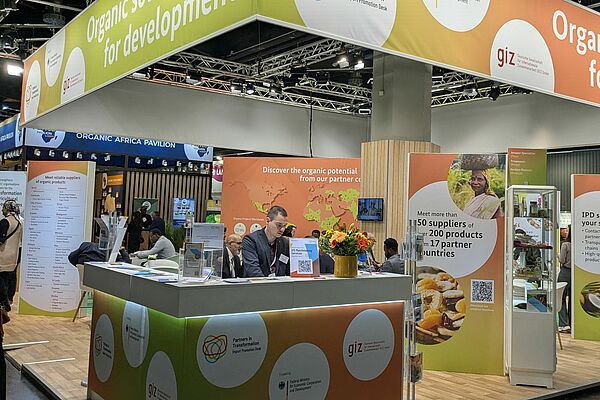
Entering the EU market sustainably with the IPD

Sustainability requirements are becoming increasingly important in global trade. Meeting social and environmental criteria, or ESG (Environment, Social and Governance) requirements, is essential for producers from developing countries and emerging economies to gain a long-term foothold in the European market. The Import Promotion Desk (IPD) prepares companies in the IPD programme for importers’ requirements through training. The aim of the IPD is to combine economic growth, the protection of natural resources and social aspects of sustainability, such as support for people in predominantly rural regions. In this interview, Tabea Mack, Head of Sourcing + Markets at IPD, outlines IPD’s approach to sustainability.
Editorial team: How important is sustainability to IPD?
Tabea Mack: Sustainability is of central importance to IPD – as a development policy project and as an import promotion initiative.
With regard to our partner countries, sustainable practices and business operations have a positive impact on local natural resources and working conditions.
As an import promotion initiative, we support European companies by carefully pre-selecting potential trading partners. Compliance with social and environmental criteria, or ESG principles, is a key requirement on the European market.
Editorial team: How does IPD support companies in the IPD programme in meeting the sustainability requirements of the EU market?
Mack: We introduced ESG training several years ago. Our approach is to highlight the fundamental importance of responsible business and to convey a holistic understanding of sustainability.
During training, we also provide companies with very specific information on the current legal framework and market requirements regarding environmental and social standards. Environmental topics include, for example, the protection of soil and water resources, the circular economy model, and the use of renewable energy. Further topics covered in training include compliance with minimum social standards in the supply chain, such as workers’ rights, occupational health and safety, and co-determination. We also address compliance issues and provide information on diversity and inclusion as part of corporate culture.
Thanks to our webinars and individual coaching sessions, companies learn to identify the key areas for action within their value chains. At the end of the training, an ESG action plan is developed, which is tailored specifically to the company.
'Sustainability is of central importance to the IPD – both as a development policy project as well as an initiative to promote imports.'
Editorial team: What are the arguments for IPD companies to invest in sustainability?
Mack: Protecting natural resources is a deeply rooted concern in rural regions. People treat nature responsibly, as it provides food for people in the region. Furthermore, fair cooperation and local social engagement have long been practised by IPD companies. Many companies therefore already have a basic understanding of and commitment to sustainability.
There are also economic arguments. Meeting the requirements of the European market is just one advantage. In addition, a commitment to ESG principles helps small and medium-sized enterprises to stand out from the competition. The ESG criteria are a distinguishing feature that facilitates access to the European market, but also justifies higher prices.
Editorial team: How do importers benefit from IPD’s sustainability approach?
Mack: Importers face major challenges: consumer demands and growing legal requirements at various levels are increasingly forcing European importers to review their supply chains with regard to sustainability.
IPD companies have the major advantage that they are familiar with the sustainability requirements of the European market and have usually already initiated the internal process. In IPD training and coaching sessions, they have defined action plans to meet sustainability criteria, which they implement step by step. They document their status and progress. This documentation provides a clear overview and a solid foundation for collaboration with European importers.
Published on