How Mexico and Germany are growing closer
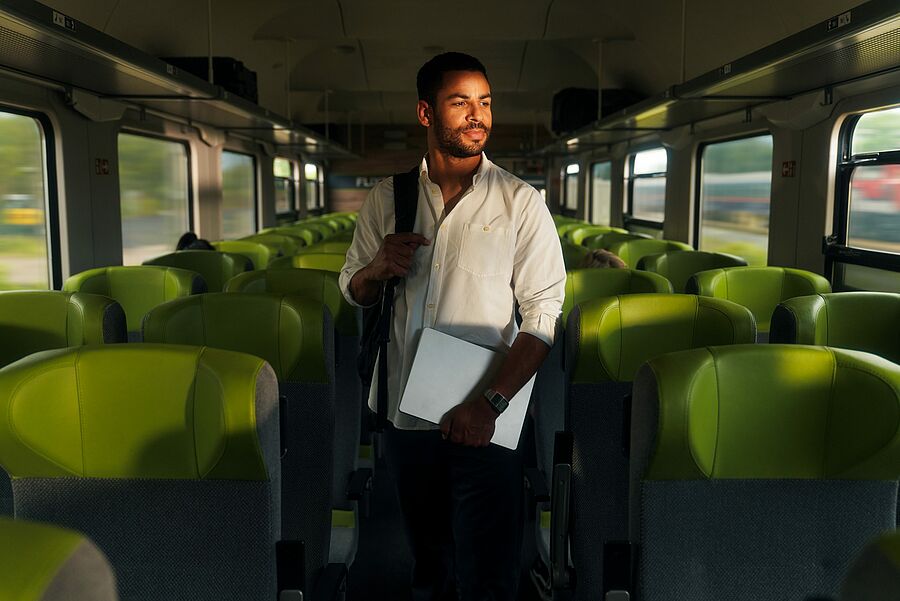
With Sebastián on the bus to Monterrey
It is early evening in Mexico City. Terminal Norte, the city’s biggest bus station, is a hive of activity. Families loaded with bags, students with backpacks, professionals with laptops – they are all getting on the green buses with the Flix logo. Among them is Sebastián Hernandez (name changed), a 23-year-old civil engineering student at the Universidad Nacional Autónoma de México, one of Latin America’s most renowned universities.
The engine hums and the bus pulls away. Some 1,000 kilometres lie between him and his home city of Monterrey. ‘There was a time when I could barely afford the trip,’ says Sebastián, gazing out the window, where the heavy traffic of the capital city is slowly starting to clear. ‘A ticket used to cost at least EUR 50. Now I pay around EUR 30. That means that I can see my family much more often. And that motivates me to study harder.’
Organisation meets improvisation
At a BMW plant in San Luis Potosí, for example, engineers from Munich work alongside Mexican experts. ‘We have observed that the Mexican and German staff work very well together,’ says Andreas Müller from the German-Mexican Chamber of Commerce and Industry (AHK). ‘In many plants in Mexico, productivity is even higher than in Europe or the USA. And I believe that this success is partly due to how well the two cultures complement each other.’ He explains: ‘In Germany, we try to mitigate future uncertainty with abstraction, standards and rules. In Mexico, the people are more flexible and find solutions spontaneously and in the moment.’
Edwin Schuh from Germany Trade & Invest (GTAI) adds: ‘The cultural differences between Germans and Mexicans are less pronounced than they are in Asia or the Middle East. Those who invest here are met with both professionalism and warmth.’ Mexico is therefore an attractive location for German experts, he continues, not least because many report that they feel welcome here. ‘Germans who come to work in Mexico are very happy because the Mexican people are warmer than the Germans.’
Responsibility as an integral part of strategy
The close economic ties are complemented by projects that prioritise social responsibility. In 2024, GIZ worked with the Mexican Business Coordinating Council (CCE) to establish an advice centre for responsible companies. It helps companies to meet their due diligence requirements in the areas of human rights and the environment.
‘With the Initiative for Global Solidarity, we want to ensure good practices – especially with regard to supply chains and the new German and European regulations,’ says Marco Pérez, who manages the project.
Another organisation to promote synergies between business and social progress is the German Agency for Business and Economic Development (AWE). ‘We aim to help German companies in Mexico to find business partners or qualified staff while, at the same time, improving economic and social development in the country,’ explains regional coordinator Peter Hirsch. One example of this is training on the prevention of violence against women in the workplace. ‘Companies that prevent violence are more successful.’
Future: electromobility and nearshoring
Mexico itself is pursuing ambitious goals with the ‘Plan Mexico’: by 2030, the country wants to be one of the world’s 10 biggest economies, reduce poverty and promote sustainability. It plans to use tax incentives to encourage foreign companies to transfer production to the country – a trend known as nearshoring.
Electromobility in particular presents new opportunities. In 2023, the government presented a national strategy that aims to ensure that, by 2030, half of all new vehicles are either electric or hybrid. German suppliers are involved in this process. ‘We want to support German companies in engaging in sectors such as e-mobility,’ says Hirsch.
A mosaic of people and ideas
Back on the bus with Sebastián. The sun has long set when the lights of Monterrey appear on the horizon. For him, it feels like a piece of home – and also a piece of the future. ‘The fact that a German company like Flix is investing here has made my life easier,’ he says. ‘And I know that many others feel the same.’
Sebastián’s story is just one aspect of the close partnership between Mexico and Germany. An alliance in which markets grow, companies expand and people on both sides benefit. Because, ultimately, it is not just contracts and numbers that determine success, but also the meeting of two cultures: German organisation and Mexican flexibility. Together, they create a formula that extends far beyond business – it shapes the future.
The text is based on the research, contacts and interviews of Alejandro Mondragon González, born in 1995, who worked for the German Agency for Business and Economic Development (AWE) until August 2025. He studied communication in Mexico City and has worked for Bloomberg as a journalist specialising in politics and business. He also completed a master’s degree in non-profit management at Osnabrück University.
Published on