
Loyal, motivated, mobile: Why recruiting skilled workers abroad is worthwhile
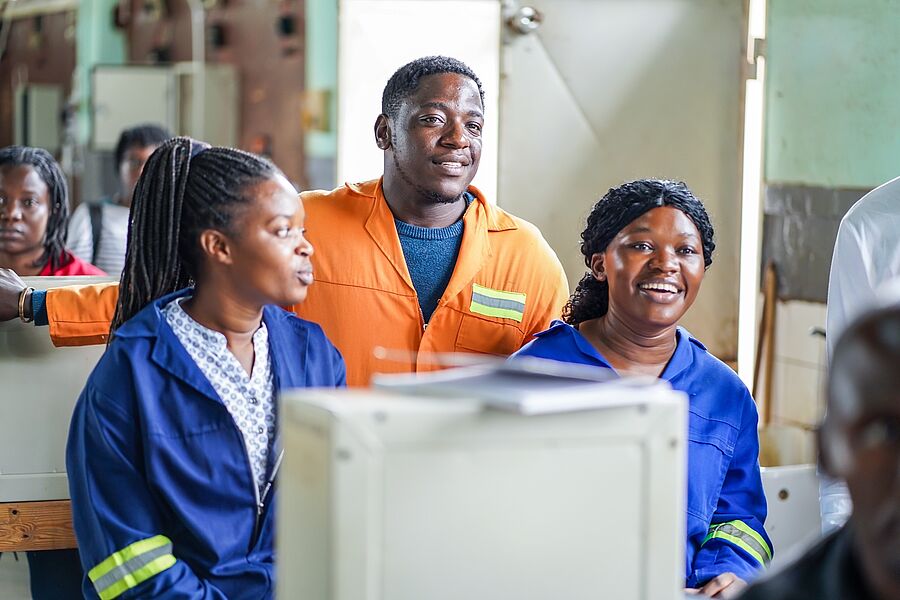
Companies in Germany often struggle to find the right skilled workers – small and medium-sized enterprises (SMEs) in particular are reaching their limits. At the same time, well-educated young people in many development cooperation partner countries are waiting for an opportunity. Companies that take on international trainees not only gain new skilled workers but also loyal, dedicated employees.
More than one in three companies in Germany cannot fill a vacancy because there are simply not enough skilled workers, according to findings published in the DIHK Skilled Labour Report 2025/2026. The DIHK survey showed that the number of companies reporting staffing challenges decreased compared to the previous year, but the problem is now primarily affecting companies where a few employees can make a really big difference: small and medium-sized enterprises (SMEs). The consequence of a staffing shortage: orders go unfilled and revenue is lost.
Companies can address this by broadening their search for skilled workers beyond national borders and reaching out to suitable candidates in partner countries of German development cooperation. In many partner countries of German development cooperation, there are young, motivated people who would love to work but cannot find jobs. They would go the extra mile, both figuratively and literally: These people are willing to pursue their professional dreams abroad, for example in Germany at the Nuremberg-based company Industrieservice Europa. There, Kenian engineer Julius Kalume works since 2025 in solar power system planning – after his successful participation in a training programme in Nairobi developed by Industrieservice Europa’s parent company.
Win-win instead of brain drain
Organisations like GIZ are therefore working on pilot projects and programmes in partner countries to bring these two worlds together. Partners from the private sector work with GIZ to carry out training and education projects, for example. A win-win situation: Partner companies benefit from the trainees’ motivation. The partner countries benefit from the new training structures established locally.
Concerns that this might contribute to an unintended brain drain in partner countries are unfounded: ‘Projects with German development cooperation are only possible if there is a significant surplus of young, well-educated people that cannot be absorbed by the domestic labour market,’ says Oliver Wagener, AWE Business Scout at the Düsseldorf Chamber of Commerce and Industry (IHK). If there is no surplus, German development cooperation organisations don’t engage.
Wagener has a concrete example: ‘We used to be very active in the Western Balkans, operating advisory centres for skilled worker migration. Those activities have since come to an end because there is a glaring shortage there – for example, among nursing staff – and the respective governments are no longer interested in promoting migration.’ In a guest article, Wagener outlines what AWE can do for companies interested in addressing their skilled worker shortage through a development cooperation project.
Successfully recruiting trainees from partner countries

Recruiter Fikri Tiraki from the HR consulting specialist Hays offers practical tips for companies serving as development cooperation partners that want to recruit skilled workers from abroad. His two most important pieces of advice: ‘The bureaucratic hurdles in Germany may be incredibly high, but they are manageable if you factor them in from the start – and seek support when in doubt.’ By ‘support’, the recruiting expert does not just mean advise from external consultants, such as that offered by Hays, but also, for example, assistance from professional associations and chambers of commerce and industry. The Bavarian association of gardeners and landscapers (GaLaBau), for example, is collaborating with GIZ on a pilot project in Kenya aimed at attracting young people to the gardening and landscaping profession. An association employee in Germany looks after the new trainees. This model makes sure that the companies providing the training do not have to handle everything on their own. What may initially sound like a lot of work pays off in the end, says the expert: ‘Even picking up a new trainee from the airport can lay the foundation for stable and, above all, long-term employee retention.’
The second tip concerns the language barrier: this should not prevent any company from hiring promising candidates. ‘Most only learn to speak German fluently once they are actually here and have integrated into the workplace,’ says Tiraki, speaking from experience. The stated level of language proficiency on paper says little about actual language skills – and even less about professional aptitude and motivation.
The professional recruiter therefore sees solid opportunities, particularly for traditional skilled trades in the SME sector, to attract new skilled workers through projects in development cooperation partner countries: ‘Tile setters, gas and plumbing fitters, bakers – these are all professions for which businesses in Germany are desperately seeking new recruits,’ he observes. Companies that are willing to look for skilled workers in development cooperation partner countries have a great deal to gain, despite the effort involved: ‘These are highly motivated, capable and, in the truest sense of the word, adaptable people,’ says Tiraki: ‘For companies that can attract them, they stand to gain main years of active support within the company.’
No contradiction: a skilled worker shortage despite rising unemployment figures?
Germany faces an apparent contradiction: unemployment figures have risen, yet companies continue to complain about a shortage of skilled workers. This contradiction becomes clear when a closer look is taken at the structure of the labour market. While jobs are being cut in the industrial sector, for example, positions in the skilled trades remain vacant: the German Confederation of Skilled Crafts estimates that around 200,000 position cannot be filled. The domestic labour market alone cannot close these gaps as quickly as would be necessary – training for new professions takes time, and the qualification requirements are high. This is compounded by the demographic change: The baby boomers will be leaving the workforce in the coming years, leaving a skills gap that will be almost impossible to bridge without targeted immigration.
Published on