

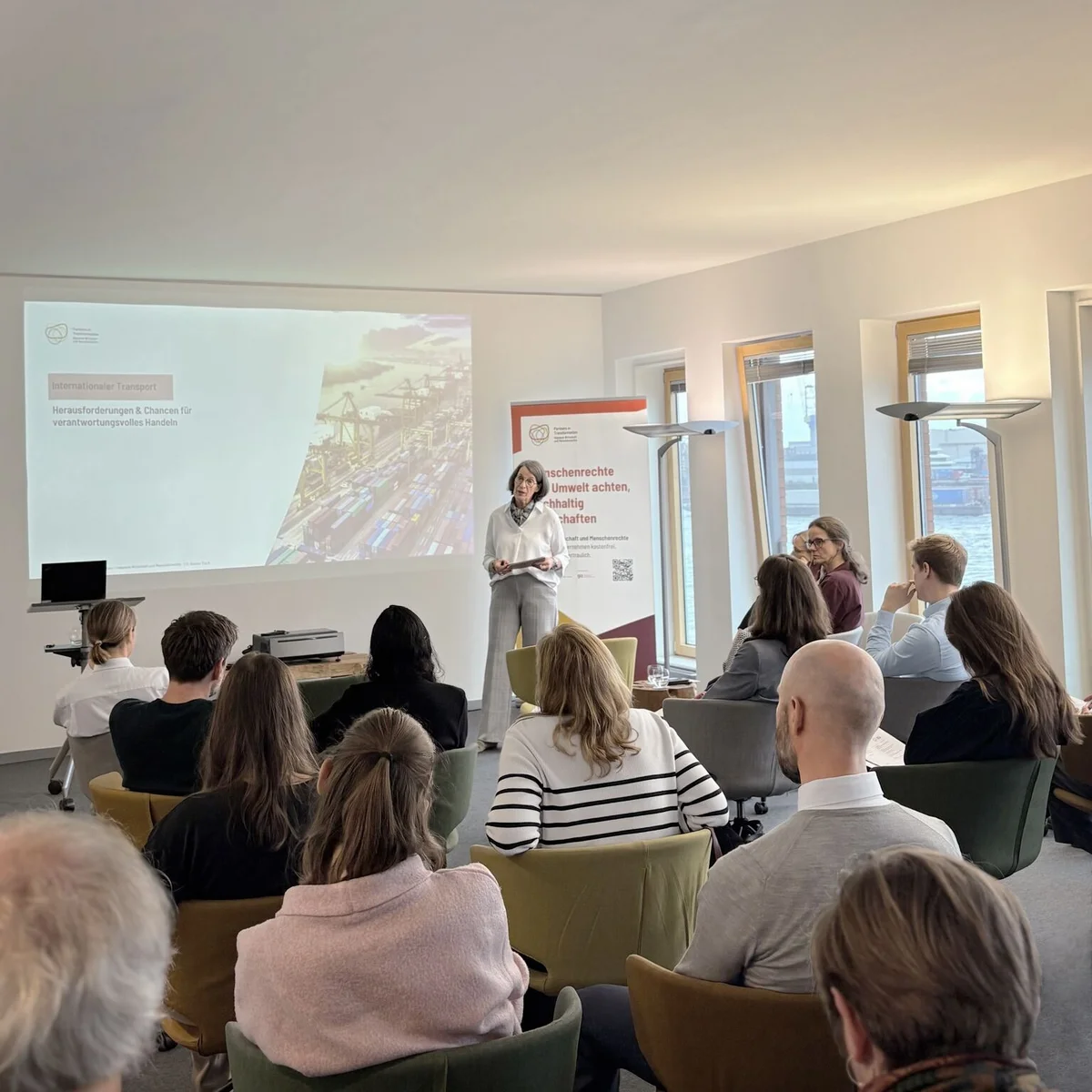
What Companies Are Dealing With in Practice
The requirements of the German Supply Chain Due Diligence Act (LkSG), Corporate Sustainability Due Diligence Directive (CSDDD) and EU Regulation on Deforestation-free Products (EUDR) are abstract for many companies – and the path from regulation to day-to-day implementation is rarely straightforward. Many companies know they need to act, but are uncertain exactly where to start, what is really relevant and how to integrate requirements into their day-to-day business without unnecessary complexity.
The real challenge lies not in access to information, but in the concrete, resource-efficient implementation in day-to-day business operations. This applies to large companies as much as to SMEs – and to directly affected companies as much as to those confronted with requirements through their supply chains.
This is precisely where our training comes in.
Our Training Formats
| Intensive Workshop 2 days | In-Person | Tailored Company Training | Funktion-Specific Training | Supplier Training | |
|---|---|---|---|---|
| Target group | Small and Medium-Sized Enterprises (SMEs) | Companies without a due diligence approach | Procurement, Sales, Compliance, Sustainability | Suppliers & Business Partners |
| Level | Company representatives 15-20 participants | Entire company 10-25 participants | Individual departments 10-25 participants | Suppliers 10-25 participants |
| Duration | 2 days IHK cooperation | 2 hours (online) to 1 day (In-Person) | 2 hours (online) to 1 day (In-Person) | 2 hours (online) to 1 day (In-Person) |
| Format | In-Person via IHK/Business Associations | In-Person or online tailored to your needs | In-Person or online function-specific | On-site, online or hybrid |
| Focus | Introduction & Orientation | Building Cross-Functional Due Diligence Processes | Advanced Functional Training | Implementation across the Supply Chain |
1. Chamber of Commerce (IHK) Intensive Workshop
The IHK Intensive Workshop is the core introductory offering and is designed particularly for small and medium-sized enterprises (SMEs). It combines guidance and initial implementation steps in a compact and practical format.
2. Tailored Company Training
Our tailored company training provides customised support for companies seeking to establish a structured due diligence process or further develop and strengthen existing approaches. Training content is developed jointly with your company and can be delivered either as an introductory training or as an advanced module focusing on specific core elements, such as risk assessment.
Understand: Positioning Due Diligence Within Your Company Context
Implement: Building a Structured Approach
3. Function-Specific Training
These trainings focus on where due diligence becomes operational: in the day-to-day decisions made within specific business functions. They translate due diligence requirements into practical action, tailored to departments such as procurement, sales, compliance, or sustainability, while remaining aligned with the company's overall due diligence approach.
4. Supplier Training
Supplier training is a key lever for implementing due diligence processes throughout the value chain. It supports companies in working collaboratively with business partners to meet due diligence requirements, delivered locally, adapted to local contexts and languages, and delivered in cooperation with local partners. Our aim is to complement existing support services, avoid duplication and create synergies.
Understand: Requirements and Expectations
Implement: Practical Measures on the Ground
Apply: Embedding Requirements into Daily Operations

Frequently asked questions
Where should we start with the due diligence process?
Your company has had little exposure to due diligence requirements so far, is unsure about the specific obligations, and has limited resources available for the topic.
Our recommendation: Intensive Workshop – provides a clear introduction, reduces complexity, and enables you to take your first practical steps.
How can we systematically embed due diligence processes into our core business?
You are already facing customer requirements or have launched internal initiatives. Some measures are in place, but a structured overall approach is still missing.
Our recommendation: Tailored Company Training – customised to your company's needs and designed to help you develop a structured due diligence approach.
We already have structures in place, but implementation remains challenging. Which format is right for us?
Processes and concepts have been defined, but implementation across business functions is inconsistent and employees lack confidence in applying them in practice.
Our recommendation: Function-Specific Training – translates due diligence requirements directly into day-to-day business practice and strengthens decision-making capabilities through simulations of real-life scenarios.
How can I effectively respond to customer requirements?
Requirements need to be passed on to suppliers, but implementation on the ground remains unclear and your influence over business partners is limited.
Our recommendation: Supplier Training – helps build suppliers’ understanding, promotes practical implementation, and strengthens collaboration throughout the supply chain.