At a glance
Why is this an important area for German companies?
Circularity is one of the most important sustainable business approaches, and offers growing market opportunities in the Global South.
What growth opportunities are available?
Global waste is projected to double by 2050. This presents an opportunity for steady growth in the circular economy.
How can businesses get involved?
Strategically, German companies have a dual role to play, both as technology suppliers and as partners in value creation at the local level.
Growth markets with structural demand
These very structural shortcomings also present economic opportunities, however. Investment in waste sorting, recycling, repair and reuse can not only limit environmental damage, but also create jobs and boost local industry. In development cooperation, the circular economy supports the transition to sustainable economic structures, helping countries in the Global South to also reduce their dependence on imported raw materials.
Although waste prevention strategies, recycling and landfill management are often still in their infancy in these countries, a policy shift is evident, primarily because of the presence of waste in many people’s everyday lives. Young entrepreneurs, too, are taking a more conscious approach to the principles of a circular economy.
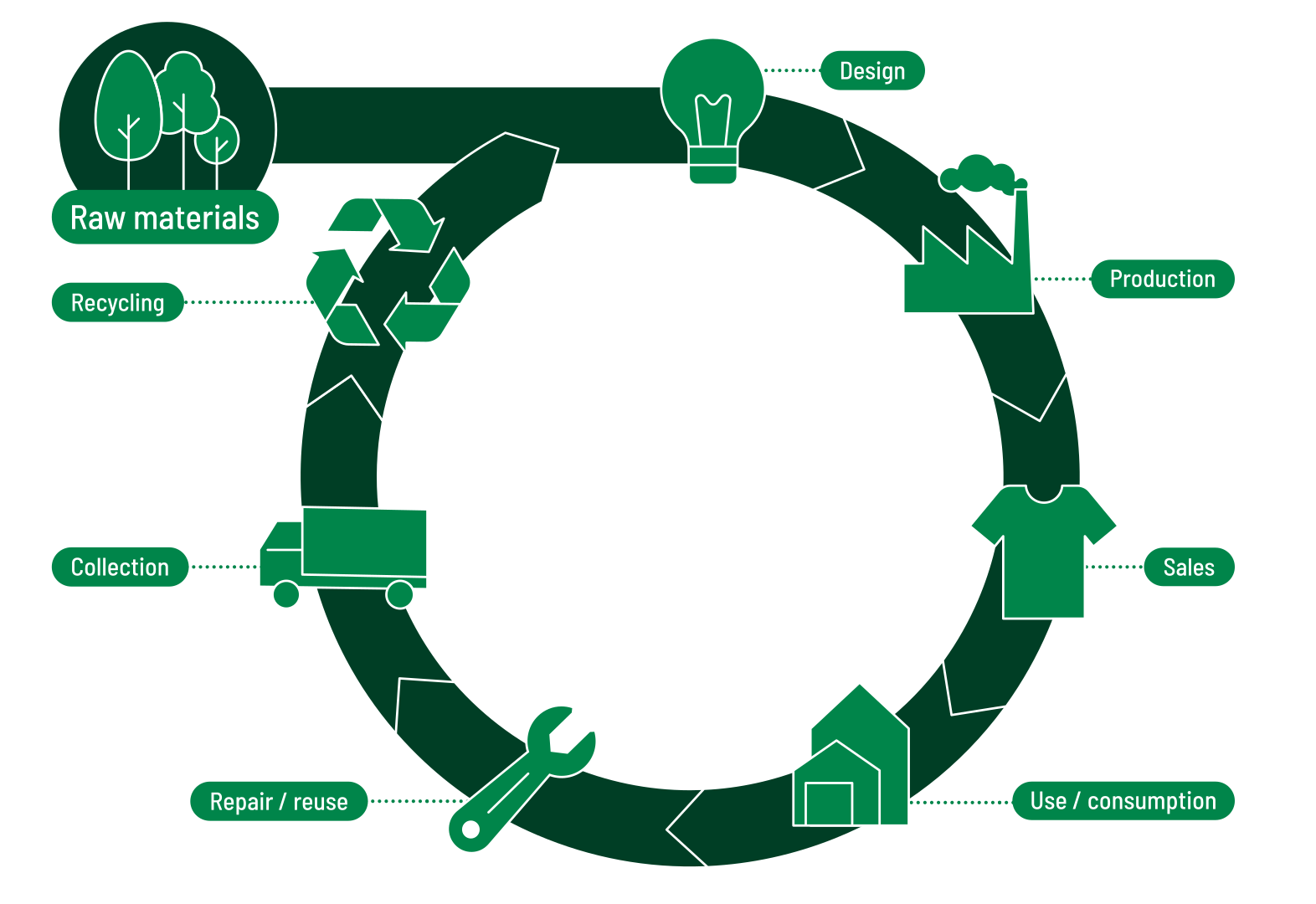
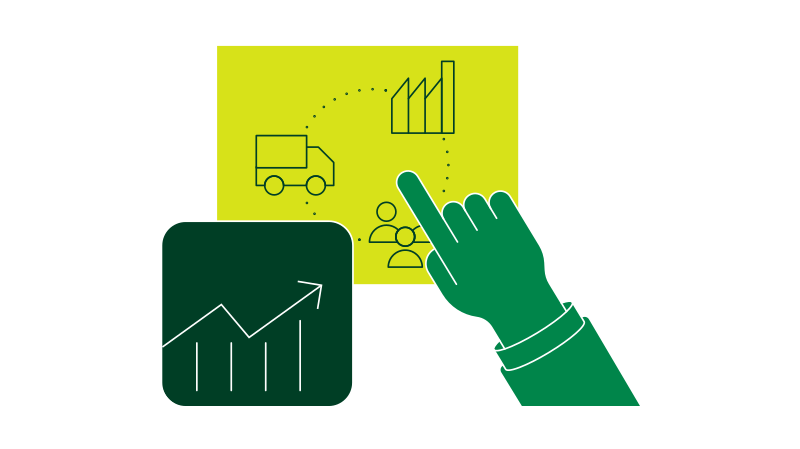
Graphic adapted from a template by plan p GmbH, licensed under CC-BY 4.0; see https://creativecommons.org/licenses/by/4.0/
More than just export markets
German companies can do more than just export waste management technologies and transfer processes to the Global South. If they operate locally themselves, they can benefit from circular economy approaches, using them to run more efficient, more cost-effective and more sustainable production lines. Expansion of the circular economy in emerging economies also offers an opportunity to make global supply chains more resilient. Reusing and recycling materials locally means German companies can become less dependent in the long term on fluctuating prices and supply bottlenecks for raw materials.
Challenges remain
According to the 2025 Circularity Gap Report, only about 7% of the global economy is circular, and this figure is actually declining slightly. One reason for this is a reliance on primary resources at a time of increasing supply chain risks. Circular economy technologies are unable to keep pace with the global economy’s consumption of materials.
For European companies, the legal framework, cheaper primary raw materials, financing, and adaptation of modern (cutting-edge) technologies to local conditions remain the main challenges on the global market. As the circular economy is generally less well developed in the Global South, requirements there differ. This different landscape means that companies need to forge a range of contacts at local level.
'Made in Germany'
German companies have been particularly innovative in the circular economy, and have had the success to prove it. According to a 2021 study commissioned by the Federal Environment Ministry, their share of the global market stands at an impressive 17%. This is significantly higher than Germany’s overall share of the global economy, which lies at just 3%. Steinert GmbH, which specialises in magnet and sensor-based sorting systems, is just one of the German companies paving the way in this field, alongside WISTEMA GmbH, which focuses on the processing of by-products and waste streams in the chemical industry.
The Agency for Business and Economic Development (AWE) has a diverse range of contacts and a wealth of expertise that can assist German companies looking to tap into circular economy technology markets in developing countries and emerging economies. In Indonesia, for example, AWE is conducting a study on how industrial parks can be transformed into eco-industrial facilities in line with circular economy principles, and the technologies required to facilitate this transformation.
Funding, networks and the Future Lab
A wide range of support and funding is already available for the circular economy, as part of the GreenTech sector. These include:
develoPPP
This support programme of the German Federal Ministry for Economic Cooperation and Development (BMZ) has already assisted numerous circular economy projects
Read more
KfW Environmental Program
Low-interest financing is provided for general environmental protection measures up to EUR 25 million
Read more
Environmental Protection Export Initiative (EXI)
The Federal Ministry for the Environment, Climate Action, Nature Conservation, and Nuclear Safety (BMUKN) provides funding for transferring know-how and rolling out environmental protection and resource efficiency technologies.
Read moreIn addition to assisting companies in submitting grant applications to DEG, KfW, GIZ and the EU, for example, AWE conducts evaluations to monitor the effectiveness of circular economy measures.
Networks are another important tool for businesses. In the field of the circular economy, these include:
PREVENT Waste Alliance
An international ‘think-and-do’ tank that promotes dialogue and supports international cooperation among over 450 institutions from the private sector, industry, academia, civil society and the public sector
Read more
German Water Partnership
A network of over 300 companies in the German water sector, with a strong international focus
Read moreThe Lab of Tomorrow (LOT) is another innovative approach. Its experts work with management consultants and entrepreneurs to develop business models, the circular economy being just one of its focal points. Initiatives to date include reducing plastic waste in Thailand, a circular food system in Rwanda, the reuse of biowaste in Serbia and improving waste management in Jordan.